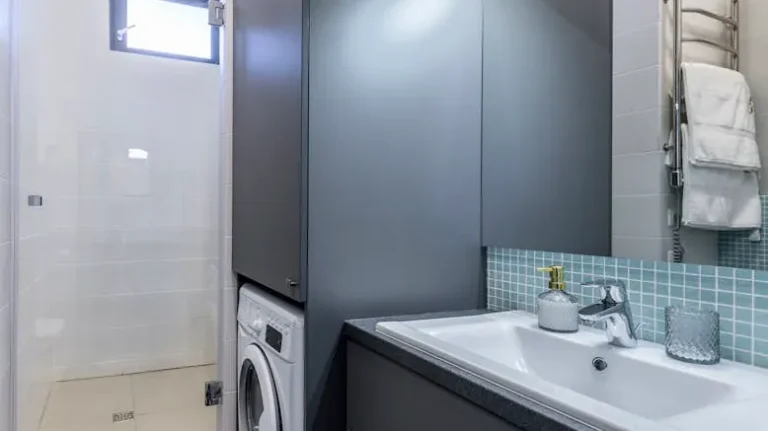
If your bathroom still has 2000s beige tile, a full remodel is not the only realistic option. A $20 contact paper update can change the look quickly, and in at least one real bathroom it held up in a checkerboard pattern even with regular moisture exposure. The useful distinction is that this is a cosmetic, temporary fix—not a substitute for replacing tile that is loose, cracked, or hiding mold.
Why the $20 contact paper approach works for some bathrooms
Contact paper is appealing because it changes the visual weight of old beige tile without demolition, dust, or a large materials bill. In Lily Tsutsumida’s bathroom, dark green contact paper applied over beige tile created a checkerboard pattern that looked intentional rather than like a cover-up, which matters in small bathrooms where patchy updates tend to stand out.
It also fits real home use better than many trend-driven DIYs because the barrier to entry is low. You need time, careful trimming, and patience around awkward spots like the toilet base or uneven tile edges, but not specialty tools or a week of downtime. For renters or owners who are not ready to commit to permanent finishes, that low-commitment setup is the main advantage.
The limit is durability over time. Moisture resistance can be good when the surface is cleaned well and the adhesive is decent, but contact paper is still a temporary skin over the tile. It can modernize the room for very little money, but it should not be treated as equal to a new tile installation.
Which low-demolition option fits your bathroom best?
Once you move beyond the initial idea, the decision usually comes down to how long you want the update to last, how much prep you can tolerate, and whether the tile surface is flat enough for a covering product.
| Option | Typical cost | Best for | Main caution |
|---|---|---|---|
| Contact paper | About $20 | Very low-cost, temporary visual change | Needs careful trimming; not a permanent finish |
| Peel-and-stick vinyl tile or luxury vinyl plank | Higher than contact paper | Floor updates with more comfort underfoot and a more finished look | Must be explicitly rated for installation over existing tile or grout lines may telegraph through |
| Tile paint | Roughly $50 to $400 | Changing color without adding thickness | Prep is demanding; wet and high-traffic areas can show wear |
| Professional reglazing | Higher-cost | A more durable refinished surface without full removal | Requires professional skill and a bigger budget |
| Full replacement | Highest cost | Damaged tile, mold issues, or layout changes | Most disruptive option |
The most important product rule here is specific: peel-and-stick vinyl should be rated for going over tile. Without that, grout lines can show through the new surface, and the finished floor can look uneven even if the pattern itself is attractive.
What prep and maintenance actually matter
Painting tile is often described as simple, but the prep is what determines whether it lasts beyond the first few months. Bathroom tile needs thorough cleaning, proper priming, and a coating designed for wet conditions—typically epoxy or polyurethane-based systems rather than ordinary wall paint. Skip those steps and moisture will find the weak spots.
Maintenance also stays part of the job after the makeover. pH-neutral cleaners are safer for coated or covered surfaces, grout should be sealed when appropriate, and failing caulk should be replaced quickly before water gets behind the finish. In a small bathroom, that kind of upkeep matters more because humidity builds faster and surfaces stay damp longer.
If indoor air quality is a concern, especially in bathrooms with limited ventilation, low-VOC paints and adhesives are the better choice. That does not make the project maintenance-free, but it does make the room more comfortable to use during and after the update.
When cosmetic fixes are enough, and when to stop and replace the tile
A cosmetic update makes sense when the tile is firmly attached, the grout is basically sound, and the problem is mostly visual: dated beige color, a dark room, or a finish that makes the bathroom feel older than it is. In that situation, contact paper, paint, or a tile-rated overlay can buy time and improve the room without the cost and mess of demolition.
You should pause the DIY plan if tiles are loose, cracked through, soft underneath, or showing persistent mold problems. Covering those conditions does not solve them. Tiling over existing tile can sometimes work if the base is stable and level, but it adds thickness, which can affect door clearance, transitions, and plumbing trim. Those are practical home-use constraints, not minor details.
For a more complete style shift without touching the tile itself, painting the vanity or adding wainscoting or board and batten can do a lot of the visual work. Beige tile tends to sit more comfortably with muted greens, greiges, and warm taupes than with stark cool tones, so those pairings can make the old tile feel integrated rather than merely tolerated.
Quick checkpoint before you buy materials
Who is this $20 fix really for?
It suits renters, budget-conscious homeowners, or anyone testing a new look before committing to a larger remodel. It is also a sensible starting point when the tile is structurally fine and the room just feels stuck in the 2000s.
Who should be more cautious?
Anyone dealing with damaged grout, recurring moisture problems, or suspected mold should inspect the tile and substrate first. If the bathroom already has water-management issues, a surface-level makeover can delay the repair you actually need.
What is the next decision point?
Check tile and grout condition before choosing the finish. If the surface is stable, a cosmetic update is reasonable. If the installation is failing, replacement is the more durable path even though it costs more and disrupts the room.